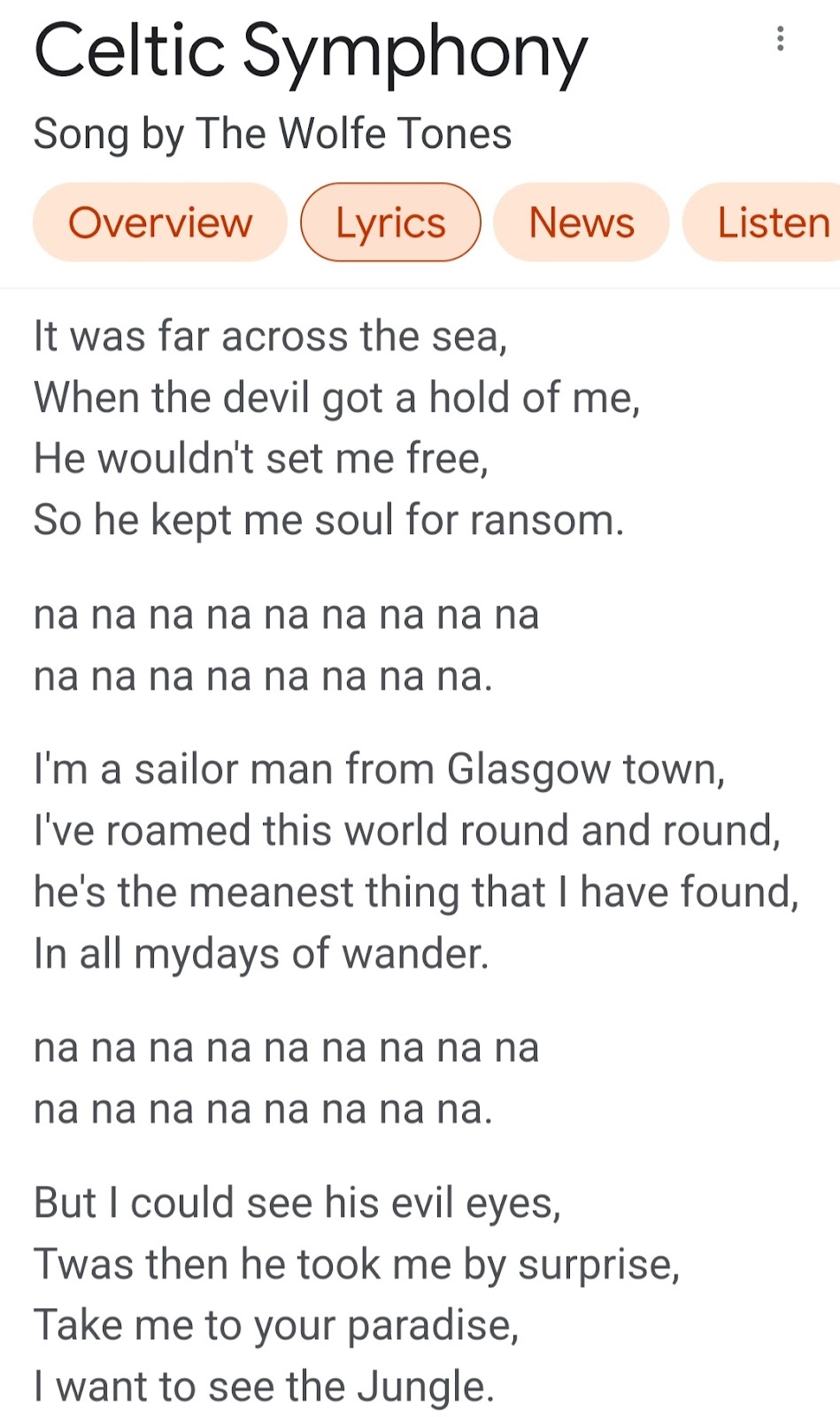
The women’s soccer team knew what they were doing: it’s just that what they’re doing means something different now The Ireland squad celebrates qualifying for the World Cup. Photograph: INPHO/FAI POOL PICTURES Thursday October 13th, 2022. As the heroes of Irish soccer, the women’s football team, danced in their dressing room, they played the Wolfe Tones’ song, Celtic Symphony, which contains the line, “Ooh ah up the ’Ra”, and they sang along. They then had to apologise for this, and be patronised by a British broadcaster on Sky, who wondered whether there is an issue with education in the team when it comes to Irish history, a ridiculous thing for someone in British media to say, given that nation’s epic blind spots regarding its own history.
There is a question about whether it’s objectively offensive to chant “up the ’Ra”, and the answer is pretty obvious: yes it is. It is offensive to victims of the Troubles-era IRA. But the broader question is, why does a context exist in which it is not just still chanted, but in fact becoming more common?
There’s another question, too, about diversity of thought in our social bubbles. I personally exist in a context where I sometimes hear “up the ’Ra” and “tiocfaidh ár lá” socially, often jokingly, but often as an umbrella toast to republicanism. But clearly many other people don’t. I also exist in a social context where many people I know abhor such rhetoric. I don’t say “up the ’Ra”, because I think it diminishes and collapses complex things into an edgy soundbite. I think it is offensive to victims of the Troubles-era IRA. By the same token, I think anti-Irish songs are also appalling, and I find English football fans singing “Rule Britannia” offensive.
The evolution of contemporary rhetoric, terminology, and discourse is driven by youth culture. But in Ireland, we have a situation where younger people are reclaiming and reinventing republican sloganeering and are then admonished by many within older generations, which is a weird exercise in political correctness in reverse.
In fairness, saying “I don’t mean to endorse the IRA by chanting ‘Up the ’Ra’,” is the same sort of thin defence as, “I don’t mean to be homophobic by calling something ‘gay’.” You kind of have to own it if you’re going to say it. The scary thing for older generations is that a lot of younger Irish people do actually own it. Maybe because they didn’t live through it. But maybe it’s also because an incredible amount of young Irish people identify as republican. Look at the polls in political party support. It’s right there.
Often, our own interpretations and disassociations regarding slogans may be honestly innocent and throwaway, but that’s not how they’re received, and it’s certainly not how similar utterances were previously contextualised. But contexts change. Younger generations are aware of the older generations’ squeamishness regarding republicanism, and this in turn consolidates their gravitation towards republicanism, because it allows for something every generation wants: a differentiating factor between generations that evokes defiance.
Katie McCabe of the Republic of Ireland celebrates with teammates after their side qualifies for the 2023 FIFA Women's World Cup after victory against Scotland. Photograph: Ian MacNicol/Getty Images
Terms like “pearl-clutching” are thrown around to diminish the concerns of the older generation. That’s unfair, probably, but the shocked-and-appalled reactions to cultural realities are also tedious to many young people. Additionally, the context that has been created for Irish republicanism to be culturally connected to new generations is also to do with how many of the tropes that previously made Irish republicanism unfashionable, and which many in older generations still think of when it comes to republicanism — macho culture, violence, sectarianism, Catholic fundamentalism — have been dismantled.
Alongside all of this, one of the unspoken generational shifts that has occurred in Ireland is the lack of deference young Irish people have towards Britain. This has to do with an Irish pride that is rooted in confidence, not fear, or shame, or feelings of inadequacy created through comparison. The balance of comparisons between both countries has changed: why would someone in Ireland be envious of someone in Britain right now? Ireland is no longer backward, and Britain is going backwards.
The Video footage: has emerged of Ireland football players singing an IRA chant in their dressing-room moments after their historic qualifier victory in Glasgow.
It is a fact that anti-Britishness is increasingly acceptable socially in Ireland, but that also has a context. It’s about disliking the British state and establishment — not British people. The British political establishment hasn’t been doing itself any favours in recent years. Simultaneously, a re-examination of British colonialism across the water has been driven by young people there, and this British discourse is also available to younger people in Ireland.
Denise O'Sullivan of Republic of Ireland celebrates after their side qualifies for the 2023 FIFA Women's World Cup. Photograph: Ian MacNicol/Getty Images
What a lot of the media and the political establishment doesn’t understand is how dominant Irish pride, patriotism and indeed republicanism is as a backdrop to new generations in their thinking, identity and in their popular culture. For the media, the absence of clarity on this issue is due to a generation gap and a conservatism in the commentariat that often sits in a pro-status-quo anti-republicanism, filtered through an anti-Sinn Féin bias.
Fianna Fáil calls itself a republican party, but the dominance of Sinn Féin has usurped its republicanism. A couple of years ago, I heard from a middle-class first-time voter that to be politically engaged in Ireland among his peers in their late teens was to be a Sinn Féin supporter. I think many journalists, for example, think that Sinn Féin has loads of support despite their republicanism, and in spite of their primary policy being Irish unity. I understand why this mental gymnastics is happening, because it would be overwhelming for many people to actually contend with the reality that Sinn Féin’s overt republicanism is part of their popularity.
Contemporary Irish nationalism is complex, but it does dovetail with an optimistic, forward-looking pride. This pride has emerged not from an oppressive context, but from a context that has opened up, where new generations have attempted to peel away oppressive forces — primarily Irish theocracy and social conservatism — and create instead a context of equality, the central tenet of republicanism anywhere.
This pride, I believe, is nonsectarian, and yet the framework of national pride that we have to work with historically was sectarian, was anti-English, and did orientate around republicanism and concepts of Irish “freedom”. It is inevitable that as this pride morphs and evolves and is distanced from the past, things will become distorted, twisted, and there will be weird outcomes, such as a group of young women footballers in a dressing room with a Spotify playlist that’s just as likely to contain the Wolfe Tones as it is Taylor Swift. It’s worth mentioning that “Up the ‘Ra” is not a new slogan to Irish soccer. Indeed, one of the most famous Irish player chants, celebrating Paul McGrath, emerged from it.
The idea that young Irish people don’t know their history is ridiculous. Yes, of course, time passes. The memories of the Troubles are not live for new generations. How could they be? That can be incredibly difficult to take for people who lived through that time, suffered during it, were victims of it, and lost loved ones to IRA violence. It requires reminding that IRA violence — as abhorrent as it was, had a context. That’s not a defence, but it is a reason.
It also requires reminding that the IRA wasn’t the only entity maiming and killing people. There is a strange, even hurtful positivity in the contemporary context. Republican slogans and memes and chants being said, sung and shared by post-Belfast Agreement generations, demonstrate the bittersweet evidence of the absence of frequent sectarian violence on this island, that the potency of these slogans has been lost because the violence has waned.
There remains a disconnect between North and South. There is a frivolity to republican sloganeering in the South that does not exist in the North. Go figure. This is perhaps yet more evidence of southern ignorance in relation to the North. How odd to see this ignorance reborn as republicanism — the very thing the nationalist community in the North failed to see evidence of from the South in terms of connection or solidarity for decades. What a strange journey for southern apathy to take. Denise O'Sullivan celebrates with Ciara Grant. Photograph: Ryan Byrne/INPHO
Questions of Irish identity abound today, and the political establishment does not answer them. If the old forces of authority — the Catholic Church, the Fianna Fáil-Fine Gael binary — have had their grip loosened, then what do we cling on to now, when those old forces of control floundered in framing identity and direction, and are therefore deemed irrelevant?
Yet it was the State that instigated something that contributed to the rise of new republicanism. The success and impact of the cultural activity and national discourse in 2016 regarding the 1916 centenary is still in the air. You cannot spend a year talking about our patriot dead, the great heroes of republicanism, offering new insights — particularly feminist framings — of revolution, literally have military parades in the Irish capital, display iconography everywhere, create multiple new avenues into this history, make it accessible, talk big ideas, and then expect people not to engage with republicanism.
It is incredibly patronising to say young people in Ireland don’t understand their history or the past. If anything, these new generations are profoundly engaged with the past (and with the future) because they have been made reassess and reimagine in ways previous generations could not, such was those generations’ experiences of oppression and indoctrination.
We are witnessing a profound cultural shift in this country that has emerged from a confluence of factors underpinned by generational change, one that is under-recognised and misunderstood. Patronising young people for their engagement with republicanism — through meme, song, philosophy, history, messy reinterpretations, culture, frivolousness, seriousness or otherwise — is wrong-headed and out of touch.
I don’t believe the women’s football team was thinking deeply about what they were singing. But that’s the thing, isn’t it? Not digging deep doesn’t mean the articulation is shallow. When something is in the culture, it’s right there on the surface, and it pops up. Yes, “Up the ‘Ra” is offensive to many people. Yes, it is chanted by many people. Yes, it is shocking to many people. Yes, it is familiar to many people. Assuming “they don’t know what they’re doing” is wrong. They do know what they’re doing, it’s just that what they’re doing means something different now.
Unless those appalled by that begin to understand the contemporary context, how Irish culture is moving, and where the politics impacted by that culture is going, they will feel even more discombobulated as Irish republicanism and Irish nationalism grow.
 Stephanie with dance partner Ervinas