Showing posts with label Liz Truss. Show all posts

Monday, 10 October 2022

Sacked trade minister Conor Burns denies ever meeting singer Mel B after claims he made remarks to her in lift

The Spice Girl made the claim after the suspended MP tweeted to say he looks forward to "clearing his name" following an allegation of serious misconduct.
 Sacked government trade minister Conor    Burns has denied ever meeting Mel B         after the singer suggested he made         an inappropriate remark to her in a lift 
           Sunday 9th October, 2022. 
Mr Burns was removed from his ministerial role "with immediate effect" on Friday following an allegation of serious misconduct.

The Tory MP for Bournemouth West has also had the whip suspended while the complaint is investigated.

The 50-year-old later posted a series of tweets where he wrote: "I will fully co-operate with the party's enquiry and look forward to clearing my name.

"I hope the party will be as quick to conduct their enquiry as they were to rush to judgement."


Mel B, an ex-Spice Girl whose full name is Melanie Brown, then retweeted his thread and wrote: "Really?? Your shocked about this complaint??? Let me remind you what you said me in lift….."

Related Topics:

Melanie Brown

The pop star hasn't elaborated on what Mr Burns is alleged to have said.

The suspended MP told the Press Association on Saturday that he doesn't recall having ever met the singer.
He said: "I believe I have never met Mel."
     One of the Tweets in answer to Mel B's                         Thread on Twitter 

The Conservative Party is understood to be looking into allegations of inappropriate behaviour by Mr Burns at the annual Tory conference between last Sunday to Wednesday.

Mel B, sometimes known as Scary Spice, attended the conference to speak about domestic abuse at a fringe event hosted by The Sun and Women's Aid.

There is no suggestion the allegation against Mr Burns is linked to the Spice Girl.

Read more from Sky News:


The sacked trade minister told journalists on Saturday the Conservative Party still hasn't told him the details of the allegation.

He said: "All I can say is that as someone who is committed to public service, to the service of my constituents, the last 24 hours have been distressing and devastating.

"I've still not had any information from the party as of the nature of the complaint. I say, as I have said in my statement, that I will co-operate fully with the party when they engage with me.

"I look forward to clearing my name".

Prime Minister Liz TrussPrime Minister Liz Truss sacked Mr Burns from his post in the Department for International Trade on Friday following the complaint, as No 10 insisted "high standards of behaviour" must be maintained.

With many thanks to: Sky News and Tom Gillespie, News reporter for the original story. 

Follow these links to find out more on this story: Conor Burns sacked after being seen 'touching young man's thigh', witness says

Friday, 9 September 2022

Prospect of Sinn Féin leading government North and South now very real, says McDonald

PARTY LEADER tells US audience there will be a referendum on Irish unity within a decade and that people are ready for a united nation
 Mary Lou McDonald and Michelle O’Neill    both predict there will be a referendum       on Irish unity within the next decade.             PHOTO: Kelvin Boyes/Press Eye. 
             Thursday Sep 8th, 2022. 
The prospect of Sinn Féin leading governments North and South is now very real, party leader Mary Lou McDonald has told an audience in the United States.

Speaking at the University of San Francisco in California on Wednesday night she forecast there would be a referendum on Irish unity within the next decade.

“We must prepare for that day. The people of Ireland are ready. We are ready to be a united nation once again.”
          OUR: Future is Irish Unity 

She described the partition of Ireland a century ago as “a disastrous act of political vandalism” that had resulted in “the creation of two reactionary states on the island of Ireland”.

“The North, the Orange state, was a place of brutal oppression and discrimination. Nationalist Catholics were excluded from power and denied jobs, employment, and basic civil rights.”

“The South became a deeply conservative state that kept women down, marginalised ordinary working people and turned its back on progressive politics.”

However, she that Ireland was now transformed and that seismic, generational change was under way.

“Today, we reach for full nationhood, for the fair and equal society our people so desperately want, and ultimately, we reach for the reunification of our country”.

She said unity was “the best idea for the future of Ireland and the greatest opportunity we face”.

    A United Ireland - Why Unification is                                 Inevitable 

“It demands that both the Irish and British governments wake up and catch up to the fact that the people of Ireland are choosing a future of unity and togetherness.”

Ms McDonald said Sinn Féin wanted to be in government because it was ambitious for Ireland and its people. “We refuse to be held back by those who are tired and out of ideas.”

She said people in their 20s and 30s were likely to be the first generation in Ireland to be worse off than their parents, adding they were locked out of opportunity and locked out of home ownership.

“This is not right. It is only natural that each generation stands and succeeds on the shoulders of their parents. That is the very bedrock of human progress.”

Ms McDonald said the driving force behind Sinn Féin in government would be the principle that each generation must advance, each generation must thrive and each generation must have the chance to make it.

Ms McDonald promised Sinn Féin in government would seize and maximise the opportunities presented to Ireland in its ability to be a powerhouse in the development of renewable energy.

She said Ireland could play a key role in decarbonising the economies of Europe. “Ireland should and can be a world leader in the production of clean, renewable energy.

“Our abundant wind resource put us in the position where our small island could be an international hub for renewables, and there exists an exciting opportunity particularly in the development of our offshore capacity and green hydrogen.”

The Sinn Féin leader said in Northern Ireland in May the people had voted for progress, for a government for all and an executive that rolled up its sleeves and got the job done.

She said the DUP “must end the boycott of democracy and of the political institutions, and work to form a government that work for the people”.

Ms McDonald told the event that as new British prime minister Liz Truss entered Downing Street “she must break with the bad-faith agenda of her predecessors and change direction, end the unilateral actions and respect international law”.

“We need to see a recommitment to the Good Friday Agreement, support for the restoration of the political institutions, and an end to game playing around the Irish protocol.”

With many thanks to: The Irish Times and Martin Wall for the original story. 


Thursday, 21 July 2022

Cambridge academic says senior Tories are 'woefully and willfully' misunderstanding the protocol's impact on the Good Friday Agreement

SENIOR Tories misunderstand the Good Friday Agreement and are using the principle of cross-community consent as a "politically expedient tool", according to a Cambridge University academic.
        Dr Niamh Gallagher, Cambridge                 University academic, author and               historian. Outside No10 Downing                          Street, Westminster. 

Dr Niamh Gallagher said there is no evidence to support recent claims that the post-Brexit trade arrangements threaten the 1998 peace accord. She argues that Boris Johnson, Liz Truss and other ministers are in "flagrant violation" of Conservative Party commitments in the Downing Street Declaration. 
The Co Armagh-born author and historian, pictured above, who was a member of the independent advisory panel on the North's centenary, has written a searing takedown of the British Government's rhetoric around the Brexit Sea Border. She looks at separate aspects of the Agreement and challenges claims that the protocol threatens it. 

             The people of Ulster voted                       overwhelmingly for parties that                supported the NI Protocol. 53 of                 our 90 MLAs support it. A clear                    majority. The actions of the                       Conservative and Unionist Party                 are against the principles of the                  Good Friday Agreement (GFA) 

She concludes that senior Tories are "woefully - and perhaps willfully - misunderstanding the Good Friday Agreement" and its relationship to the protocol. Last night Dr Gallagher told The Irish News that her scrutiny had revealed that "no-one has done their homework on the Good Friday Agreement" to have "no selfish strategic or economic interest in the North of Ireland".
Her meticulously researched paper, published on the History and Policy website, is a searing takedown of the current British Government's rhetoric around the Brexit Sea Border. It comes against the background of ongoing efforts by the Conservative administration to legislate to disapply elements of the deal the UK and EU signed off on a little over 18 months ago. 
The Cambridge University associate professor in modern British and Irish history, who was a member of the independent advisory panel on the North's centenary, says it is the Tories who in their political representations as to why the NI Protocol Bill must be introduced, have broken their commitment to the peace process that their predecessors of the 1990s did so much to bring about.

The paper looks at separate aspects of the Good Friday Agreement and asks if the accord is threatened by the protocol, as claimed. It investigates the "alleged disruption to power-sharing" and concludes that the key pillar of the Stormont institutions is not under threat but that the "problem lies exclusively with the DUP and its actions over the NI Protocol". She argues that power-sharing in the region has always been "rocky" and there is no evidence of "wider political disengagement which should cause concern about governance in the North of Ireland". 

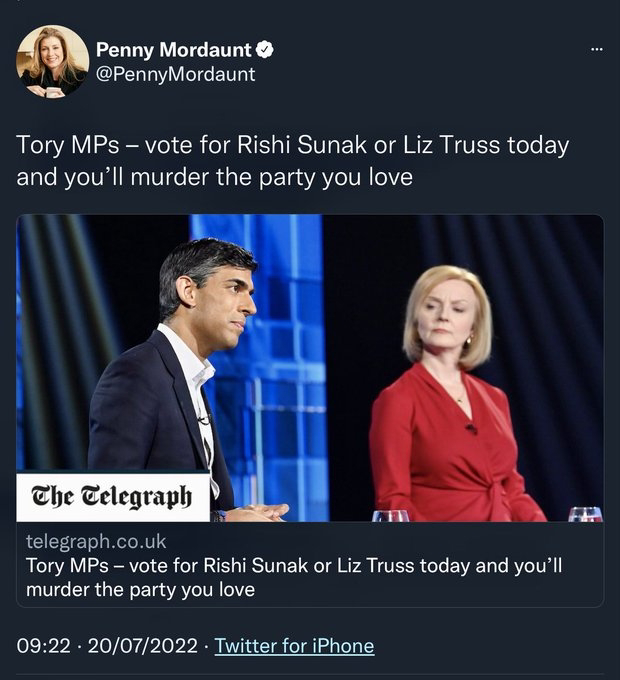
    The last remaining two running in the       leadership challenge for prime minister,                Rishi Sunak and Liz Truss                                
Dr Gallagher argues that many senior Conservatives are using the principle of cross-community consent as a "politically expedient tool" and questions whether there is any legal basis to "protest the protocol on a consent basis". She believes there has been a "considerable misunderstanding" by the prime minister and foreign secretary about what cross-community consent is, noting how Strand One of the agreement is exclusively about "democratic institutions in the North of Ireland". In all of this strand's clauses, the Stormont assembly, not Westminster, has exclusive authority over cross-community consent. 

"Cross-community consent is therefore the preserve of the NI Assembly and concerns internal relations," her paper states. "It is not for the UK government to interfere with nor any other co-guarantor. It is exclusively about institutions, not policies." The academic also highlights numerous instances where the Westminster government ignored cross-community consent to pass legislation, including the outworkings of the 2016 Brexit referendum, the introduction of abortion legislation in 2019, and the recent Legacy and Reconciliation Bill. 

Of the latter Dr Gallagher says: "It is one of the few policies opposed by all groups in NI and the Stormont Assembly without exception, yet the British government presses ahead with the legislation, railroading over consent... On none of these occasions did 'consent' matter to the UK government in its setting of policy. This is fundamentally because consent does not apply to policy." 

She also notes that the UK government originally made the provision that a simple majority, rather than a cross-community majority, would suffice for an assembly vote every four years on the protocol. The paper also highlights the "misunderstanding" of east-west relations as detailed in Strand Three of the agreement. The author notes that rather than relating to the North of Ireland and Britain in the manner interpreted by Liz Truss, Strand Three's focus in on the relationship between the Republic and Britain. 

Dr Gallagher told The Irish News last night that her scrutiny had revealed that "no-one has done their homework on the Good Friday Agreement". "No-one's opened up the document and looked at it thoroughly and compared it to the rhetoric that's coming out of the government ministers' mouths - I think that's especially important because we're now in the committee stages of the bill," she said. 

With many thanks to the: Irish News and John Manley POLITICIAL CORRESPONDENT for the original publication.

Follow these links to find out more on this story: Guardian View on overriding the Brexit treaty: a national disgrace


Monday, 13 June 2022

UK Protocol Bill: Conflict with the EU inevitable

The UK Protocol bill is expected to strip out a swathe of provisions, not because they make the EU implement the Protocol more zealously, but because the UK does not like them

So toxic is the atmosphere in Westminster about the *orthern Ireland Protocol and the forthcoming bill to overturn it, that senior figures in Brussels and elsewhere feel they have been here before.
             Saturday 11th June, 2022. 

"This is like all the s***-stirring that went on in 2018, when people were briefing and counter briefing," says one UK official. "It makes it bloody hard for those of us who are trying to find a solution."

Boris Johnson has courted the hardline European Research Group (ERG) to try to cling to his position following his worse than expected confidence motion win on Monday, while one of his challengers, the Foreign Secretary Liz Truss, has courted the ERG precisely to take Johnson's place if he is ousted during the summer.

There were reports this week that Truss was reprimanded by Johnson at a divisive cabinet meeting for taking too hard a line on the bill. Michael Gove and Rishi Sunak also raised their concerns, fearful that a trade war with the EU is not what the UK economy - which the OECD warned would next year have the slowest growth and highest inflation of any developed country - does not currently need.

"This isn't just cabinet ministers versus cabinet ministers," said the official. "There is department versus department. There are people within the civil service who are uncomfortable being asked to do stuff they're uncomfortable doing."
       Liz Truss listens as Boris Johnson            speaks during a Cabinet meeting on                               17th May. 

Worsening the atmosphere is a row over whether the bill will break international law or not.

When the UK introduced the Internal Market Bill (IMB) in 2020, the Northern Ireland Secretary Brandon Lewis admitted to the House of Commons it would break international law "in a very specific and limited way".

This time around Liz Truss has told the House of Commons the new bill, which would breach the Protocol in an even more fundamental way, "is legal in international law".

As the legal expert David Allen Green has written in his Law and Policy blog, ministers want cover to tell the MPs who will vote for the bill that they are voting for something which is legal.

However, governments sometimes shop around for legal advice if the advice they are given by their own most senior law officers does not comply with their political objectives.

This was the case with the then Attorney General Lord Goldsmith on the legality of the Iraq War. The Chilcot Inquiry found that Goldsmith’s shopping around for the right advice was "far from satisfactory".

On 11 May, the Times reported that the current Attorney General Suella Braverman had decided the bill to rip up the Protocol was legal in international law, because the Good Friday Agreement (GFA) had "primordial" superiority over the Protocol.

This was because the EU had created "a barrier in the Irish Sea and [was] fuelling civil unrest".

In other words, the GFA was a more "important" treaty than the Withdrawal Agreement.

As David Allen Green suggests, British governments normally turn to a senior external legal figure, known as the First Treasury Counsel, for advice on a particularly tricky piece of legislation if there is a constitutional dimension.

According to reports by Sam Coates of Sky News and Adam Payne of Politics Home, the government had, indeed, turned to the current First Treasury Counsel James Eadie QC.

However, he was not asked for a legal opinion as to whether the bill broke international law or not. Instead, he was asked to simply confirm that the government had received a range of advice from other lawyers.

He had been asked only to "assume" that there was a "respectable legal basis" on which to support the arguments made by the other lawyers, according to the reports.

However, according to the Sam Coates report, Mr Eadie left something of a fly in the ointment by saying that the advice of one particular lawyer was "considerably easier to follow and more convincing", and that lawyer had argued that it would be "very difficult" for the UK to argue it was not breaching international law.

According to David Allen Green, this is an unholy mess.

"Somebody senior internally is insisting that the First Treasury Counsel be consulted, and that the Attorney General’s convenient advice cannot be accepted on the nod," he wrote.

Mr Eadie’s arms-length role provoked questions in the House.

SDLP leader Colum Eastwood challenged Boris Johnson on Wednesday to respond to reports Johnson had "refused to consult the First Treasury Counsel on his plans to rip up the Protocol".

Johnson responded that the reports were not correct. But he doubled down on the Braverman idea that the GFA was a superior treaty.

"The most important commitment that I think everybody in this House has made is to the balance and symmetry of the Belfast/Good Friday agreement. That is our highest legal international priority," Johnson said.
      Johnson told parliament that the                Good Friday Agreement was his                  highest legal international priority 

On Thursday the Liberal Democrat MP Alastair Carmichael said Johnson’s answer was, at the very least, "incomplete".

He asked Minister of State James Cleverly to clarify the situation.

"While Sir James [Eadie] was consulted on aspects of the proposals, he was in fact asked not to give an opinion on whether the plan would breach international law and was told to assume that there was a respectable legal basis for the government’s position."

Cleverly replied the government was "confident our actions are legal under international law". He said it was a long-standing tradition that governments did not publish legal advice.

On the BBC’s World at One on Thursday, Jonathan Jones, the former chief legal officer in Johnson’s government who resigned over the Internal Market Bill, himself cast doubt on the legality of the bill.

"The government knew about the Good Friday Agreement when it entered into the Withdrawal Agreement, including the Protocol. It has since argued in litigation in the Northern Ireland courts, that the Protocol was deliberately and carefully designed so as to protect the integrity of the Good Friday Agreement."

This gets back to the secondary charge: that the problem, therefore, is the way the EU has implemented the Protocol.

"If the argument is the EU side is failing properly to implement the agreement," said Jones, "which is another way of saying the EU itself is in breach, then that would give rise to different remedies for the UK. But it would not be a justification for the UK itself unilaterally to rewrite whole swathes of the Protocol."

Despite this, MP Conor Burns, who is Minister of State for Northern Ireland and Boris Johnson’s unofficial envoy to Washington, insisted the UK was "taken by surprise" by the way the EU was implementing the Protocol.

"There was a degree of surprise at the scale of implementation versus the perceived risk, that is absolutely fair to say," he told the Northern Ireland Affairs Committee on Wednesday.

"We did not believe that the EU would insist on the full panoply of checks on product moving to stay in the Northern Ireland marketplace to be sold and consumed in Northern Ireland, which poses zero risk to the single market… we remain the most aligned nation on earth to the EU’s regulatory model."

However, what the UK has argued since the spring of last year, and what Monday’s bill will legislate for, is an entirely new Protocol, not a better way of implementing the one that exists.

Indeed, the bill is expected to strip out a swathe of provisions, not because they make the EU implement the Protocol more zealously, but because the UK does not like them.

This is what has caused EU capitals to harden their position.

"From what has been leaked about the nature of what they're going to do," says one EU diplomat, "the European Commission is quite taken aback about the extent to which they're rewriting the Protocol. It’s not just tinkering or removing elements that may cause irritation, it's a wholesale rewrite. It's just riding a coach and horses through the whole thing."

As such, France and Germany in particular are increasingly furious at what Boris Johnson is poised to do. "The big member states are incandescent with rage," said the diplomat. "They're extremely annoyed that a country could take this attitude to an international agreement."

Diplomats complain that at the same time, the UK is becoming increasingly truculent at being denied access to the EU’s Horizon science funding programme, insisting that this is part of the Trade and Cooperation Agreement (TCA) and nothing to do with the Protocol.
"The Commission is basically saying, well, we have profound legal concerns about your commitment to fulfilling your legal obligations under the Protocol," says one diplomat. "So, we can't admit somebody where we've got such profound concerns about their capacity to abide by their legal obligations."

The Irish Government, meanwhile, has been quietly lobbying leading political figures to convey the implications of the current course of action. "Anyone you can think of who may have had influence, or has influence, in the Conservative Party," says one Irish source.

And yet the machinations in Westminster suggest that such warnings are having no impact. "So far, London just seems to be involved in its own internal debate. It’s a bit like the good old days when London negotiated with itself," says the source.

The bill has been drafted since last autumn, and various hard and soft versions have evolved with the final course of action being chosen by Boris Johnson, with cabinet approval coming during the week.

In simple terms, a key choice has been whether the bill would immediately disapply aspects of the Protocol, or whether it will enable ministers in future to do that through secondary legislation.

As of Thursday, the drafting was finished, but there were still different versions there for the taking.

"Everything's been drafted," says one source familiar with the process. "Lawyers haven't been asked to draft anything new, so this is all now about the politicians putting the jigsaw together and deciding what bits they're going to put in and what they want to leave out."

On Tuesday, with most of the drafting done, there was a call between the Northern Ireland Office, the Foreign Office, the UK department of Agriculture (DEFRA) and a range of Northern Ireland stakeholders.

The presence of DEFRA officials appeared to be significant. For those who believed that the appearance of the bill itself would simply be to shock the European Commission into bigger concessions on how the Protocol works, this signalled a degree of detail surrounding a "dual regulatory regime".

This was announced by Liz Truss in the House of Commons on 17 May. It would be the engine to prioritise the UK internal market over the EU single market, by largely abolishing checks and controls on goods moving from Britain to Northern Ireland.

Under this idea, traders in Britain who were selling into the single market could choose to follow EU standards, and those who were just selling into Northern Ireland would follow UK ones.

Either way, the means of reassuring the EU that unregulated goods were not leaking into the single market across the land border would be to have robust "in-market surveillance" and criminal sanctions against traders who breached the arrangement.

However, Northern Ireland businesses, especially on the agri-food side, immediately saw where this might lead.

"DEFRA were talking about what needs to happen in a dual regulatory regime," said one source who joined the call. "Northern Ireland businesses say this will help businesses in Britain, but not Northern Ireland ones."

In other words, a dual regulatory regime for agri-food would be seriously problematic because of tightly-woven cross-border supply chains, and the mixing of ingredients from north and south, especially when it came to finished products being sent to the rest of the single market, or taking part in future EU-third country free trade deals.

The dairy industry was immediately alarmed. Northern Ireland sends one third of its raw milk (800 million litres per year) across the border for processing, but if Northern dairy cows were fed on British grain which was not produced to EU standards, then that milk would not qualify for processing in the South.

"It works currently because the whole of the supply chain is working to EU standards," says a senior Northern Ireland Dairy Council figure. "But if you have part of the supply chain that isn't working to EU standards then you can see the problem we have."

According to a number of sources on the call, the UK idea would be that the in-market surveillance would be such that the EU would not feel the need to put up a customs or regulatory border anywhere.

Such an approach is, as the sources pointed out, redolent of the "magical thinking" and "alternative arrangements" of 2017 and 2018.

Among the risks are the UK following through on its plans to diverge from EU standards.

"Say you have divergence in pesticide residue in food," says one senior agri-food industry source. "We bring it into Northern Ireland, but it doesn't comply with EU rules. So, it's circulating in Northern Ireland. What's to stop a farmer coming north to fill his trailer with wheat from Northern Ireland?

"He can't get it from England through Dublin because they're using banned pesticides. It’s more expensive elsewhere, so he comes north to get it.

"What does Ireland do when that happens? You can’t have that sort of stuff in the single market. Explain to me how we don't have a [sanitary and phytosanitary] land border, if we're running with one set of standards in Northern Ireland that Europe would not accept in the single market."

The source adds: "If the UK is going to make a success of this, they need to deliver in terms of internal market controls that prevent that happening. The degree to which they need to be robust is not to manage 70% of the risk when you're dealing with food. You need to deal with 100% of the risk."

However, with the furious back-and-forth on the drafts, it appears Liz Truss was receptive to the lobbying of the ERG and DUP who wanted to make sure the bill was not watered down.

Both the Financial Times and the Unionist Voice website reported talks between those groups and the Foreign Secretary on Tuesday. They wanted stronger language on the removal of VAT and the European Court of Justice (ECJ) from the Protocol, drafting which held up the publication of the bill on Thursday.

Unionist Voice suggested that the enabling powers the bill will give future ministers will be enshrined in a "constitutional framework" so that any trade between Britain and Northern Ireland (and vice versa) must ensure the "constitutional integrity" of the United Kingdom and be compliant with the 1801 Act of Union.

Needless to say, all these legislative moves will be regarded by EU member states as the UK entirely rewriting the Protocol on its own terms, to placate both the DUP and the ERG.

As of Friday, it appeared that the bill had dropped some of the detail of how the dual regulatory regime would work, and had placed more emphasis on powers that ministers could have in future, rather than what powers they would have immediately. 

"That tells me they're looking for a get-out-of-jail-free-card," says one official familiar with the drafting process. "It's heavier on the implied powers to ministers than giving them direct powers. That's a way of saying, we're giving you powers but it's up to ministers how to use them. 

"With the passing of the bill, it will allow the UK to soften its approach, rather than going in all guns blazing," said the official.

It is also likely that describing a Dual Regulatory Regime in great detail in the bill will be a treacherous exercise, given how vividly *orthern Ireland stakeholders have said it cannot possibly work.
   Maros Šefčovič meets Liz Truss earlier                                 this year. 

None of this is likely to reassure capitals. Maros Šefčovič, the chief Protocol negotiator, will issue a statement on Monday after the Bill is published, and will brief EU ambassadors on Wednesday. 

It's understood that the EU could unfreeze legal action against the UK shortly after that, and perhaps add more infringement proceedings to the list of non-compliance cases that were frozen. 

WHAT THEN?

The bill could be given a second reading on 20th June, at which point the UK government would spell out further detail on the bill's true intention. Downing Street would then hope the Bill could reach committee stage before the summer recess. 

That would mean ammendments being added in the autumn (a febrile time with party conference season). This is where rebels could put hurdles in the way of the regulations that would start to disapply key parts of the Protocol, such as requiring a report by the *orthern Ireland Affairs committees in both the Commons and the Lords. 

This then turns Parliament into a bear-pit, reminiscent of 2018. Once again, the EU will see this as London brawling with itself. 

There is some hope, albeit faint, that, as the bill makes its way through the Commons and to the Lords, negotiations will resume on the EU's October proposals to make the Protocol more flexible. 

"In that period, there would be a hope that some sort of continuation of discussion will be found before legislation is actually enacted," says one EU diplomat, "and that London would see some sense and be prepared to investigate with the Commission more fully what the flexibilities the EU has in mind would actually look like if they were put into operation." 
Given the hardening demands by the ERG and DUP, that seems unlikely. This is the corner that the UK under Boris Johnson has painted itself into. 


Thursday, 9 June 2022

Prime Minister Boris Johnson holds secret NI Protocol talks to appease the DUP and backbench Brexiteers

Boris Johnson has held secret talks with the DUP and Tory backbench Brexiteers amid pressure to harden up legislation overriding swathes of the NI Protocol. 

         Wednesday June 08 2022.
  Boris Johnson, here meeting DUP leader     last year, is trying to allay the fears of            the right of the party ANDREW              PARSONS/NO 10 DOWNING STREET 

Whitehall sources told The Times that the legislation had undergone "substantial redrafting" after Monday's confidence vote in an attempt to allay concerns of the Tory right. 

Controversially the new law was discussed at a meeting on Tuesday night between Johnson, Liz Truss and a representative of the European Research Group (ERG) of Brexiteer Tory MPs. 
One source said Johnson had agreed to make changes to the legislation before other senior cabinet ministers had seen details of the bill or been consulted on the changes. 

They added that the latest draft of the bill had "lost any pretence that it was in accordance with international law". 

"Simon Case [the Cabinet Secretary] has very serious questions to answer about how this was allowed to happen," they said. 

"It is a complete abuse of the normal process of government. It has slight shades of how the legal advice over the Iraq war was constructed." 
The legislation was discussed on Wednesday at a meeting of the Global Britain strategy committee that includes Truss, Rishi Sunak, the chancellor and the *orthern Ireland secretary Brandon Lewis. 

But senior ministers objected to changes to the legislation demanded by the ERG and the bill has been sent back again to the foreign office for further redrafting. 

Among the changes demanded by the ERG was a new clause that would make clear that the legislation has primacy in UK law over the Brexit withdrawal agreement that includes the *orthern Ireland protocol. 

They also wanted the bill to explicitly bring to an end the jurisdiction of the European Court of Justice in *orthern Ireland and include a "sunset clause" when EU regulations would no longer apply in the province. 

But after the cabinet meeting these demands have been watered down with one source saying the final legislation would look "much like" previous government plans. 

The Times understands that as well as Tory Brexiteers, senior government figures have extensively consulted the DUP on the substance of the new law. 

Downing Street had hoped that by strengthening the provisions in the Bill the DUP would agree to nominate a speaker to the Stormont Assembly and allow ministers to return to their departments even if full power-sharing is not restored. 

"The DUP is critical. We need them to take steps to go back into government as it supports the case for action," a source said. 

But there were warnings that the new clauses in the bill would make it much harder to pass the legislation through the House of Commons and infuriate Brussels. 
MP Damien Green with MP Simon Hoare 

A number of senior Tory MPs have already expressed concerns about the legislation including the chairman of the *orthern Ireland select committee Simon Hoare and Damien Green, the former de facto deputy prime minister. 

One government source said the latest version of the bill would lead to "another major row over the government breaking international law again". 

They said: "The plan was to have at least some sort of legal fig leaf. But when you explicitly make it clear that you're preparing to overrule the withdrawal agreement then that's gone." 

     Sir Bill Cash Conserverative MP and                      senior ERG member. 

It is understood the meeting in Downing Street last night involved Sir Bill Cash, a senior Tory member of the ERG and chairman of the Commons European Scrutiny committee. 

It is highly unusual for individual MPs - who are not ministers - to be involved in the drafting process of legislation before it is officially signed off by ministers. 

The Times understands that at the time the meeting took place the legislation had not been subject to "write round" - a process by which ministers are consulted on government decisions. 

One source said the changes had been introduced at the behest of the ERG, which was unhappy at previous versions of the bill. They said civil servants were "deeply unhappy" with the way in which the process had been handled. 

With many thanks to: The Times and Oliver Wright and Stephen Swinford for the original publication. 

Follow these links to find out more on this story and more information regarding the NI Protocol: When even the Attorney General flouts the law what hope does Britain have - Suella Braverman.